Essay
2026, AI and the Enterprise
Why are companies not seeing the same acceleration that individuals are with AI?
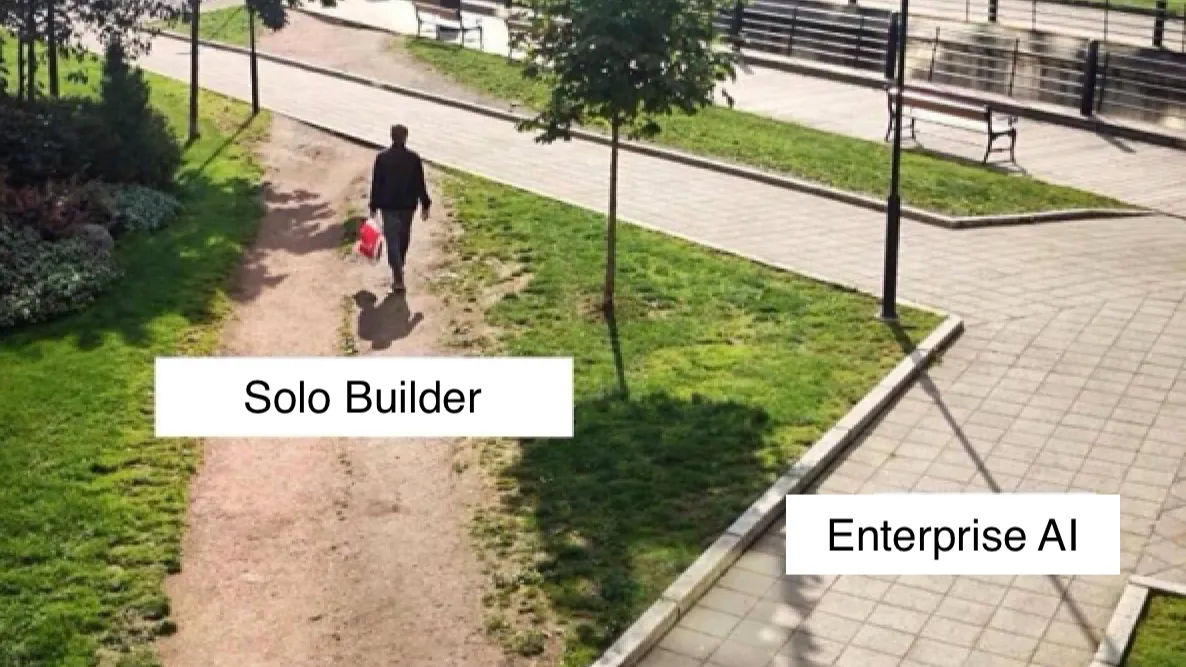
2026 is a wild time in enterprise technology. For people hands on with AI every day the capability and power at their fingertips is like nothing before. The average engineer is moving 3-10x as fast in all they are doing. Perhaps faster as they master building and managing swarms of agents.
Despite this, most enterprises are not really seeing that sort of gain. 88% of organizations now use AI, yet 95% of AI pilots delivered no measurable P&L impact. This all comes in the face of $30-40B of enterprise investment in the space. Sit with that for a sec. Has there been another time in history where this degree of focus, energy, and capital has gone in without outcomes?
While the above numbers come from some widely quoted studies by McKinsey and MIT, it mirrors the scuttlebutt at meetups and happy hours. Building at home from an open start anything is possible; at work it’s a lot harder to make the same progress. And this mismatch is landing as a problem on the CTOs and technology leaders. Having been close to this problem space I’ve jotted down some ideas on why AI impact feels so different for the individual and the enterprise.
- Unit of adoption != unit of value: “Tokenmaxxing” may go down as the shortest fad of 2026, yet it illustrates this point aptly. Driving higher adoption has been showing a straight line to costs but has failed to draw a line to value. On a greenfield effort a solo builder may be dispensing with decades of previous best practice and finding value rapidly. Imagine taking that to the workplace with no translation: the disruptions would challenge decades of process, roles, careers, even the day-to-day vernacular. Many enterprises are paving the footpaths of existing processes to avoid these disruptions. System redesigns create threats up and down the organization, tool adoption does not. But broad tool adoption on existing processes is only an incremental benefit.
- The SDLC was just one link in the enterprise build chain: If you take a really simple version of how enterprises operate it looks something like: strategy -> build -> operate. As AI collapses build time towards zero, the massively outsized gains are not showing up in the rest of the enterprise process. And notably AI is potentially making strategy and operations harder problems. 2026 on, the most important question may be: what do we do, and more importantly what don’t we do?
- Foundational AI-ready debt: Gartner projects organizations will abandon 60% of AI projects through 2026 due to lack of AI-ready data. Why isn’t data ready? Decades of system sprawl, M&A, and fragmentation. Why was it never fixed? Data was operational exhaust, not a product. Similarly legacy enterprise codebases are not ready for agents. AI agents are as good as the context they can gather. Monorepos and even monoliths (at times hated antipatterns) are becoming favored for AI development, especially with harness engineering as a way to keep context readily available.
- Context starvation is endemic: Context gaps and context starvation might be the primary cause of failure for any AI system anywhere. Without context agents are like PhDs with amnesia. In the enterprise all that context lives in heads, tribal norms, and undocumented processes. To borrow from point 3 above, if you are trying to implement a fix where the context on a critical dependency lives in a different repo. And the agent has no way of reading that repo, you and the agent are toast.
- Probabilistic technology inside deterministic accountability: Some Principal Engineers have become predominantly merge conflict arbiters, Applied Scientist spend days managing a myriad of new AI-authored data science models from anywhere in the organization, the CTO desk starts filling up with vibe coded business apps. The enterprise was built with human accountability, but AI is handing tools to people that never had that accountability and so it lands on someone else’s desk. Either accountability has to shift, or things break on human attention bandwidth.
- The incentives invert with depth: For individuals adopting AI as a way to do their jobs better, it is basically all upside. The Dev using Claude Code, the PM using Glean are only going to get faster and better at their jobs. But as the deeper disruption happens and agents are stood up for roles or specialization gives way to generalization, people’s livelihood suddenly are at stake. The same dichotomy plays out in the business as marketing, finance and other functions start to be automated. Transformation depends on the voluntary contribution of tacit knowledge by exactly the people its success would disrupt. Until there is a bridge that brings everyone into the solution the incentives are not aligned.
- Standard measurement language doesn’t exist yet: AI adoption wants a set of metrics that will do for it what DORA did for devops. “Cool, everyone thinks we are going faster but the token bill doubled and the P&L hasn’t moved.” 2026 feels like the year where teams are getting serious about managing this: putting API gateways in place to measure at a finer grain how tokens are spent and starting to manage token budgets more carefully. That and shifting past curiosity on open weight models. But until more formalized measures come in, enterprises lack the measurement and valuation apparatus for what AI actually changes, so funding oscillates between hype-driven overinvestment and proof-demanding retrenchment.
- The Meta: AI is not popular for a number of pretty rational reasons. It’s hard to love a tech that is constantly being predicted to take all jobs, destroy the climate and potentially drive humanity to extinction, by the very people creating it! My personal take is I worry a lot more about how people will use the technology than about the technology itself. I fear a future like the movie “Elysium” way more than “Terminator.” But regardless the zeitgeist is complex for AI and that can be a direct impediment.
It’s notable what is not on the list: AI intelligence. It’s a hot take, but I think the output of AI (when properly fed with context) has reached the point where it is consistently as good sometimes better than what you might get from a similarly expert person. The common root beneath all eight: AI’s constraint is not model capability but institutional design, and culture.
Companies were not built for AI, they were built to be run by and for humans. Yet AI works differently in so many ways: it offers profound benefits, but also profound challenges to ways of working, beliefs and processes that have been carefully developed for decades. Reaching for the deeper root cause: with so much radical change afoot why are we not seeing enterprise change radically?
Workflow redesign is the single most important and most avoided lever. McKinsey’s March 2025 report (“The state of AI: How organizations are rewiring to capture value”) found that “out of 25 attributes tested, the redesign of workflows has the biggest effect” on EBIT, yet only 21% of adopters had “fundamentally redesigned at least some workflows.” This is the empirical anchor for the “unit-of-adoption vs. unit-of-value” mismatch.
2026 feels like a moment where these factors start coming to a head. Incumbents will increasingly face AI native startups that are thinking through their processes from scratch, rewriting their roles, and imagining enterprises where: AIs do; humans steer. In the face of that pressure change is ultimately coming no matter what.