Essay
Don't Waste a Crisis: Rebuilding a Brewery's Sales Engine in a Month
When our only sales rep moved on, we leaned in, and a month inside a real business turned into the sharpest feedback loop I've had with AI.
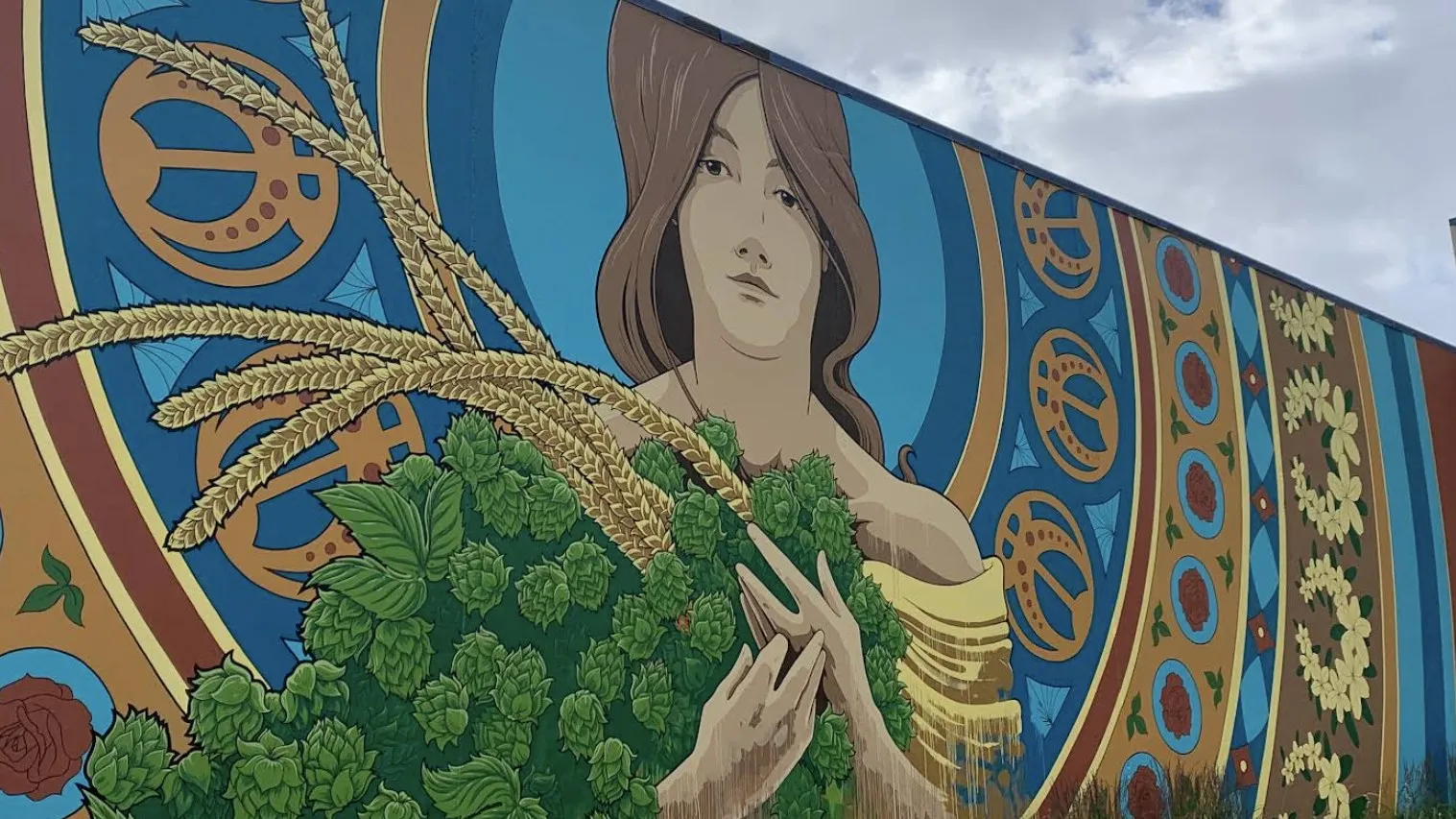
About a month ago, our only sales rep at Obec Brewing moved on. Over five years he built our wholesale business from scratch, and it came exactly when we were emerging from Covid and needed it most. We owe him a lot, and we’re genuinely excited about the opportunity he took.
It also left us with a problem. We could simply backfill the role, hand wholesale to a distributor, or lean in and see if we could grow. In the spirit of “don’t waste a crisis,” we leaned in. We hired a new sales rep who had been working retail for us and showed potential. I have been a partner at Obec for over 9 years now, it has never been my day job, but I dove in on this to see if we could use technology and AI to level up.
Problem 1: Our data lived everywhere
One of my partners had built a thoughtful process in Smartsheet for tracking account activity, account health, and kegs. That was a great starting point, and the first step was wrapping it in a real app and database. Almost immediately, though, it was clear we had a data fragmentation problem. Worse, several of our systems were never designed to be integrated. Our order management system is a mid-aughts Ruby app with zero APIs anywhere.
Pre-AI, this is the kind of problem where the juice isn’t worth the squeeze. Each of a dozen data sources needs to work together with enough fidelity to provide action and insight. And in a previous life each of those efforts could have been months. But not in 2026, a week later, we had integrations across a dozen internal and external systems to create a foundational data fabric for our sales business.
Problem 2: Our account knowledge lived in people’s heads
Did you call that account? When did we last visit? For five years, some of that went in Smartsheet and some in the order system, but mostly it lived in people’s heads.
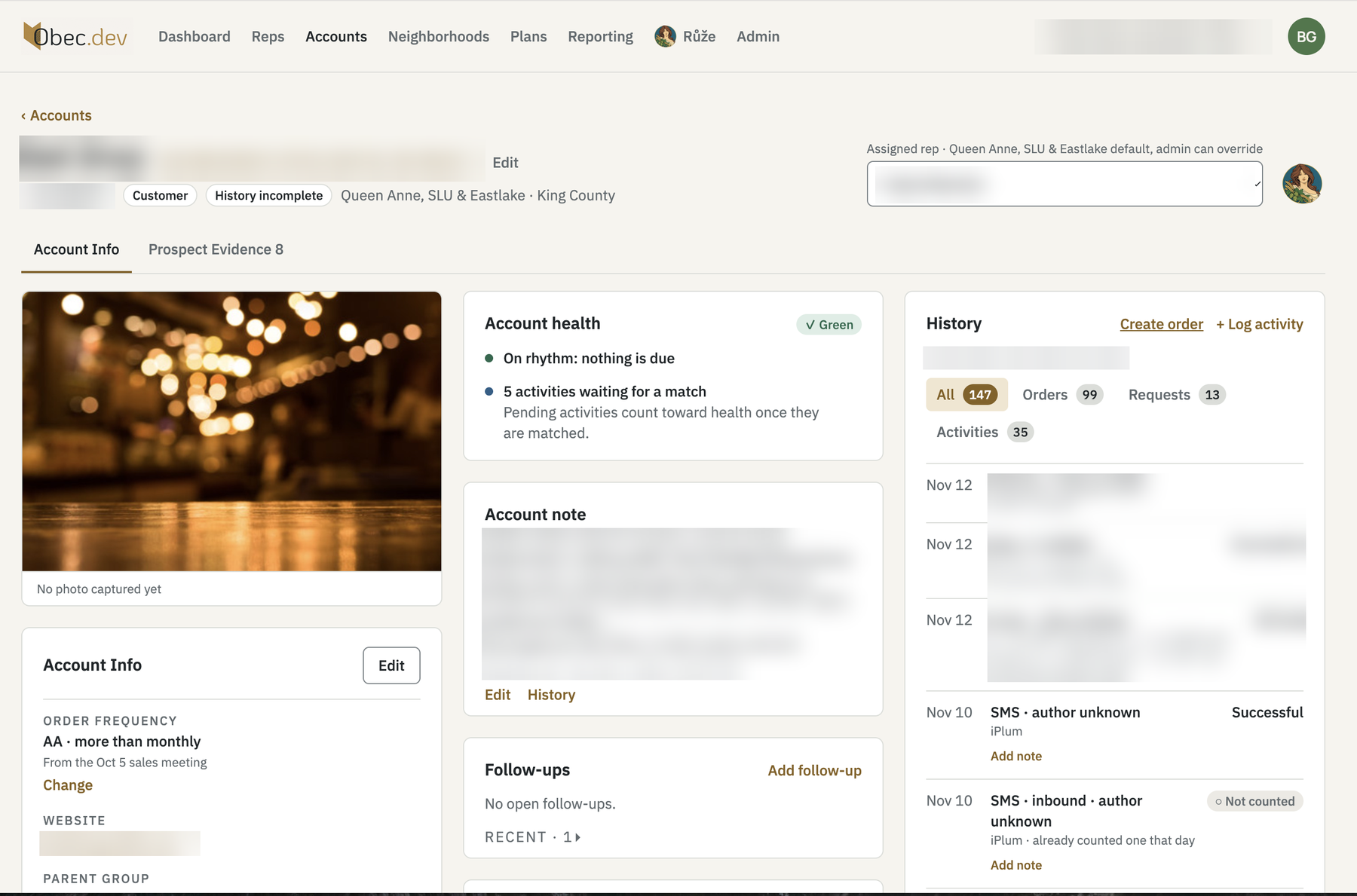
So we connected our email, calls, and texts to our accounts. That forced some data discipline: which email and phone number belong to which account? More importantly, it laid a foundation of context. We now had not just a record of what we did, but the conversations happening over time.
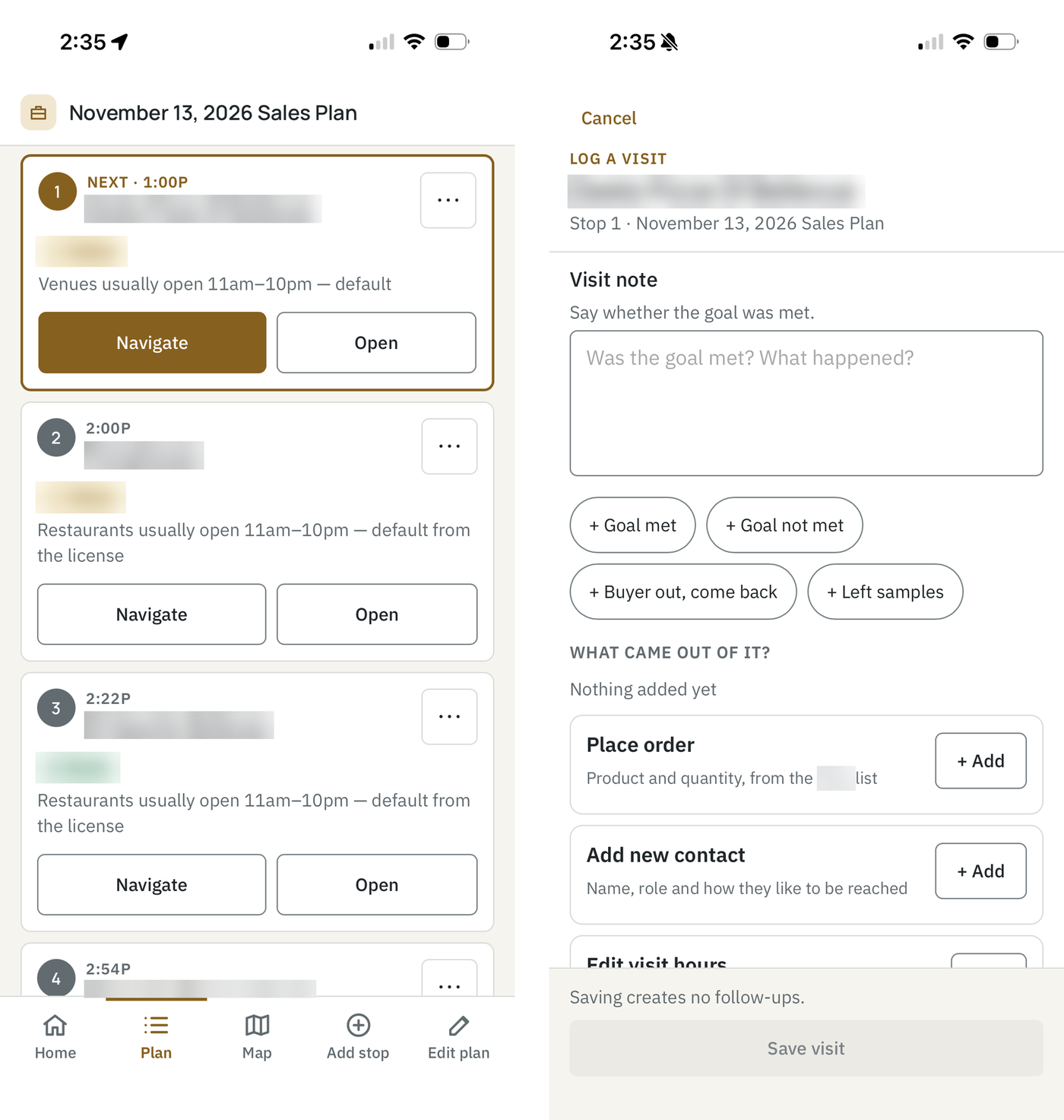
Then came visits. We built a field app that our rep or delivery driver carries to log contacts, orders, hours, and follow-ups, all feeding a single account history.
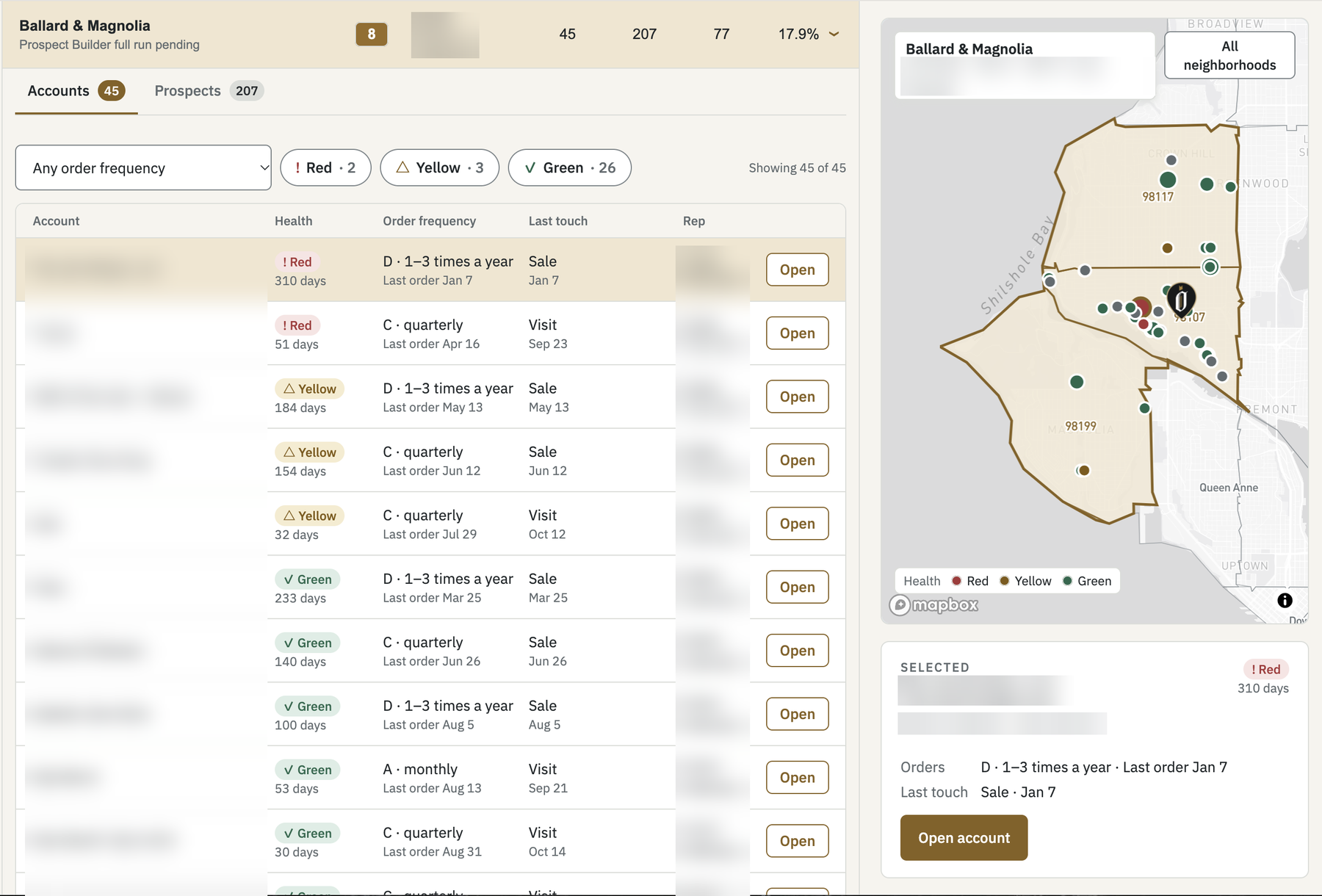
With those pieces in place, we could finally build the account health dashboard we’d always wanted, one that weighs order patterns, sales activity, the type of business, and even drive time.
Problem 3: Where should we grow?
Washington has roughly 15,000 licensees that can sell beer. Which doors should we walk through? There are a lot of Puget Sound neighborhood markets. Most carry a couple of distributor beers, and a few champion local craft and buy direct from self-distributing breweries. How do you tell the difference? Similarly, a well-made Czech Pils pairs with a lot of restaurant menus, but which restaurants would actually buy from us?
Driving to every prospect isn’t realistic. So we built a crawler that finds each venue’s website and looks for clues. Beer-focused places often publish their tap list, and when the crawler finds one, it’s gold. You know they care about beer, which beers they pour, and how many taps they have. Our former rep had also shared the rules of thumb he used to size up a prospect.
We combined his judgment with the data to score every licensee in the state from 1 to 10. A brewery pouring its own beer scores a 1. A craft-focused taproom with a deep tap list might score a 10.
Perhaps more critically was crawling for operating hours. You can drive around a lot and not have any impact if there is no one there when you visit!
Monday morning
Now Monday morning starts with real triage: which accounts need attention, how best to give it, and which prospects are worth walking in to introduce ourselves and drop off a fresh sheet. Our new rep started the day after go-live. Instead of learning our accounts from whatever was in someone’s head, she started with a full account history and a planned route on day one. Some of the early outcomes we are seeing:
- More customer contact. Recorded touches with accounts nearly doubled against our September–October average, and texts went from a handful a week to more than 40.
- Route plans get worked. Over 90% of planned stops turn into a visit, with notes for what’s next.
- Follow-ups close fast. The app raises its own follow-ups (enter an order, mark a delivery, reply to an email), and most close within a day, some within the hour.
- Early revenue is encouraging. The first two weeks of November are well ahead of the same period in October, before any of this existed. It’s too early to credit the app, but it’s the right direction.
Emerging from the AI fever dream
The initial build took about two weeks, field app another week, then a couple of weeks of testing in the field. A typical day: build a delivery plan in the morning, drop kegs at accounts, and flag sales follow-ups. Then come back, refine the app so each piece works better in the real world, rebuild it overnight, and test it again the next day.
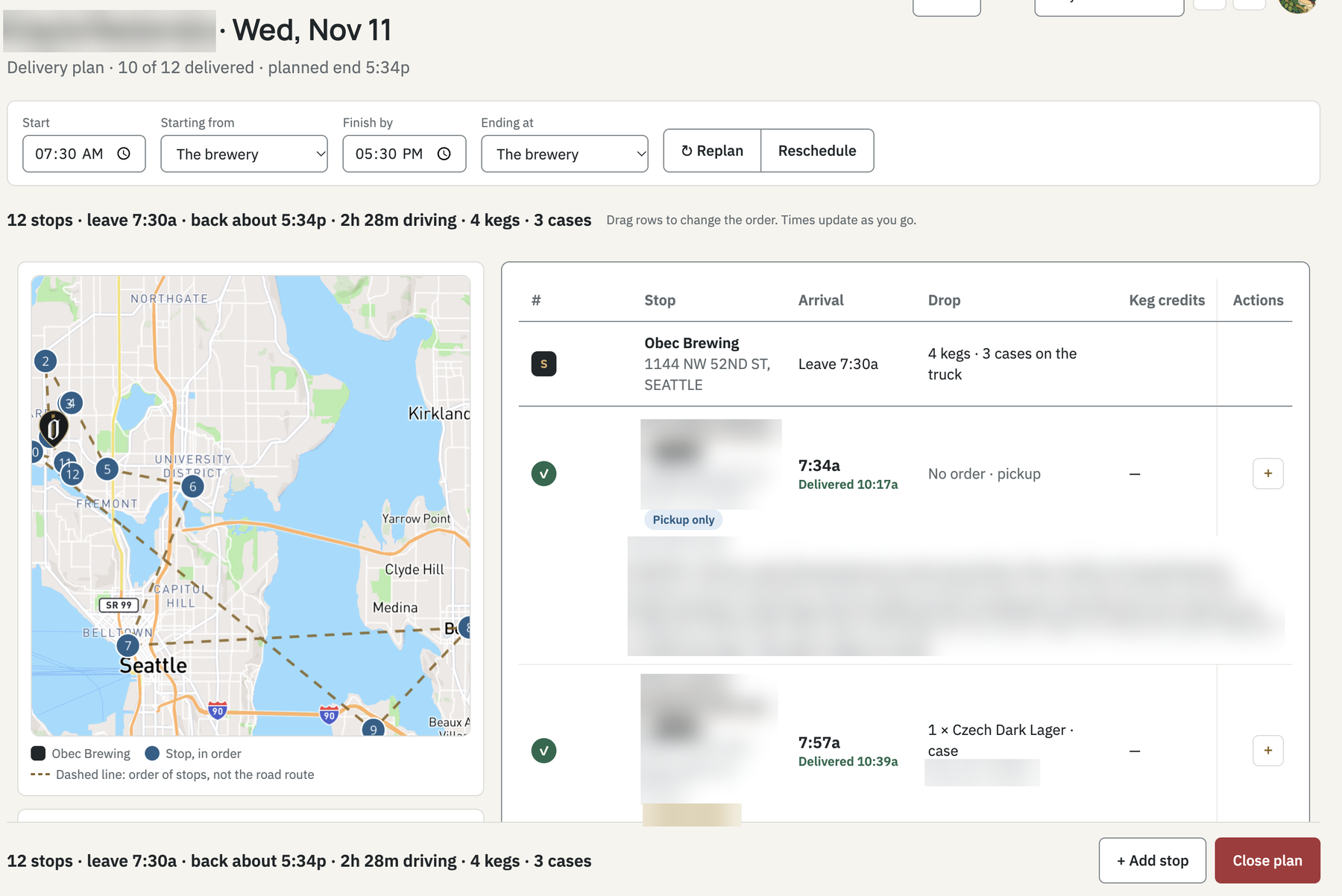
For me, this was a real transitionary moment to clarity: this sort of feedback is the lifeblood of building a valuable product. I know I’m not alone in this: for people who love to build, it’s easy to get lost in the sauce with the AI echo chamber. The fever dream is real. You can build in weeks what used to take years. This application is evidence of that. But customer results are the waking reality. And when you combine on the ground interaction and feedback with hourly or daily releases, real world outcomes start becoming the rapid measure of success.
Agentic Practicality
For AI in the app, there’s no shortage of manual workflows to take on, and for now we’re testing with both headless access and agents inside the app to see which fits where. The app’s agent, named Růže, after the avatar/mascot for the brewery that adorns our lager cans, is so surprisingly useful: “Hey Růže, the English Brown just came available again, can you pull all the accounts that have ordered it in the past and draft an email letting them know it is available in sixtels and ½ barrels?” This is mostly a measure of the data foundation that was built.
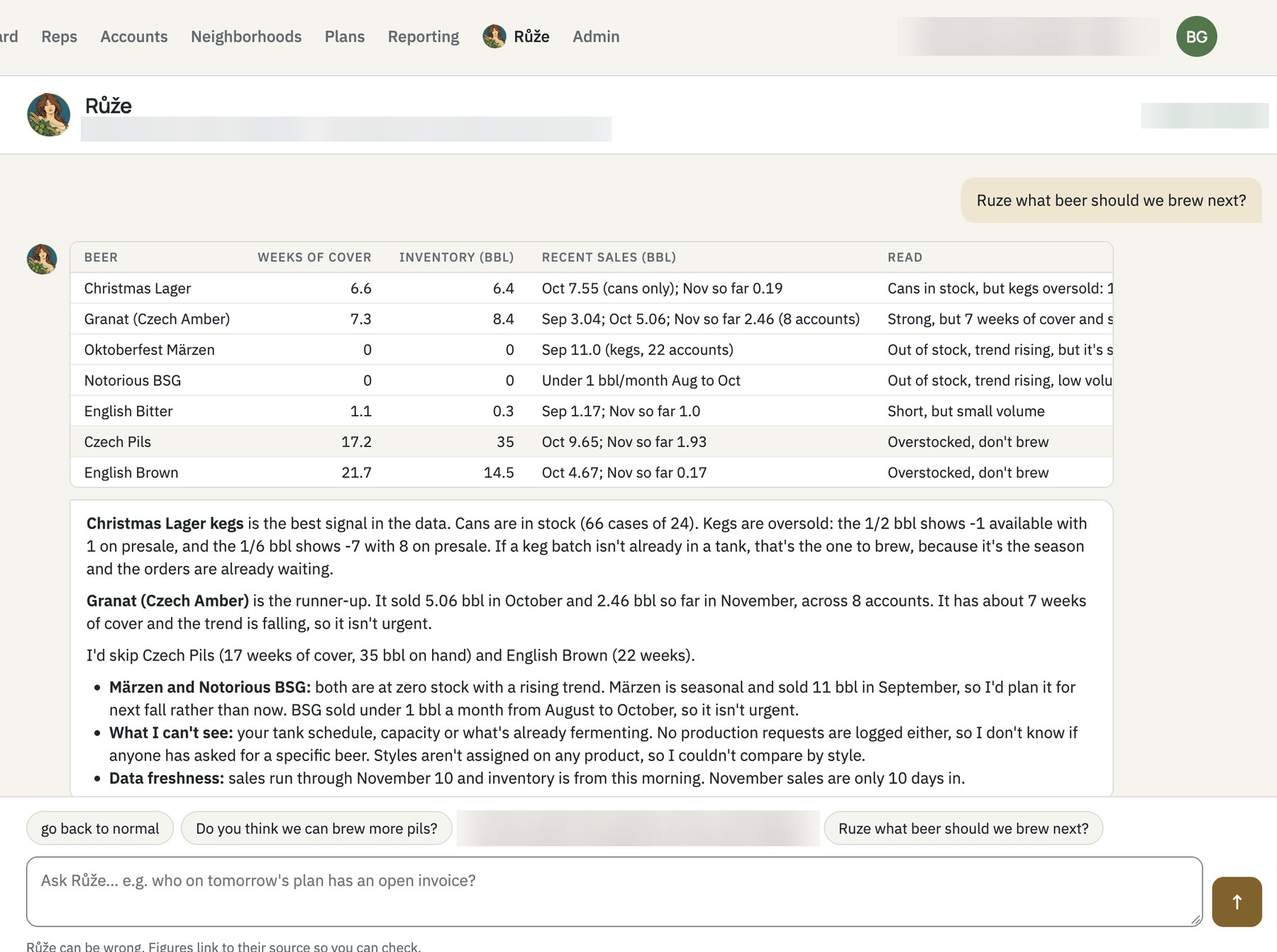
Behind the scenes Růže works proactively to find, flag and increasingly fix anything that needs attention. She captured an order coming in that we had missed just yesterday. She’s started drafting the weekly fresh sheets and sending them out. Like so many small businesses Obec is a tiny shop, any activity that can be taken on is an opportunity to better apply attention somewhere else. As I write this, a half dozen agents are running in the background, optimizing delivery and sales routes - a surprisingly intricate problem.
What’s Next
We recently sat down with a sales rep from another brewery to get feedback. The general reaction was: “How can I get my hands on this?” That was validating. Is there a business here? As beer software, probably not a big one. Alcohol sales are a different legal maze in every state, and craft brewing is a low-margin, shrinking market, so a brewery TAM slide wouldn’t impress anyone. But that was never the point. From the start, the goal was to make one brewery better. If we couldn’t do that, the bigger question was moot.
What I know for sure is that building from inside a business, on an hour-by-hour feedback loop, produces incredibly sharp signals about where the value really is. And the pattern isn’t unique to beer. Legacy systems that don’t talk to each other, critical knowledge living in people’s heads, and a team that needs better answers on Monday morning describe a lot of businesses.
What this did to my harness
This month was also an acid test for my agentic harness. Real business work broke a few of my assumptions. I ended up ripping out big pieces of how it drives long-running work, and rethinking how it maintains a canonical knowledge base and manages dependencies between tasks. My next post will cover what broke, what I rebuilt, and why.
Real-world outcomes turn out to be the sharp edge between the AI fever dream and the waking reality for harnesses as well as businesses.